 KH
 FR
 AR
 CN
Francophonie: Where Does This Community Come From?
AKP Phnom Penh, October 26, 2026 --
Since the 18th century and the philosophical ideals born during the Age of Enlightenment, the French language has had a unique characteristic: it embodies values intended to be universal. The first and most important bearers of these values were writers. This was why the Association of French-Language Writers (Association des Écrivains de Langue française – ADELF) was established in 1926. At the time, its mission was to reward writers, both indigenous and expatriate, who expressed themselves in French in territories where the language was spoken. This marked the dawn of what is now known as Francophonie.
Following decolonisation, President Charles de Gaulle sought to transform France’s relations with its former colonies into a form of multilateral cooperation in the cultural field. This gradually took shape through the establishment of several organisations, notably the Association of Partially or Entirely French-Language Universities in 1961, now known as the Agence universitaire de la Francophonie (AUF), and the International Association of French-Speaking Parliamentarians in 1967, now called the Parliamentary Assembly of the Francophonie (APF).
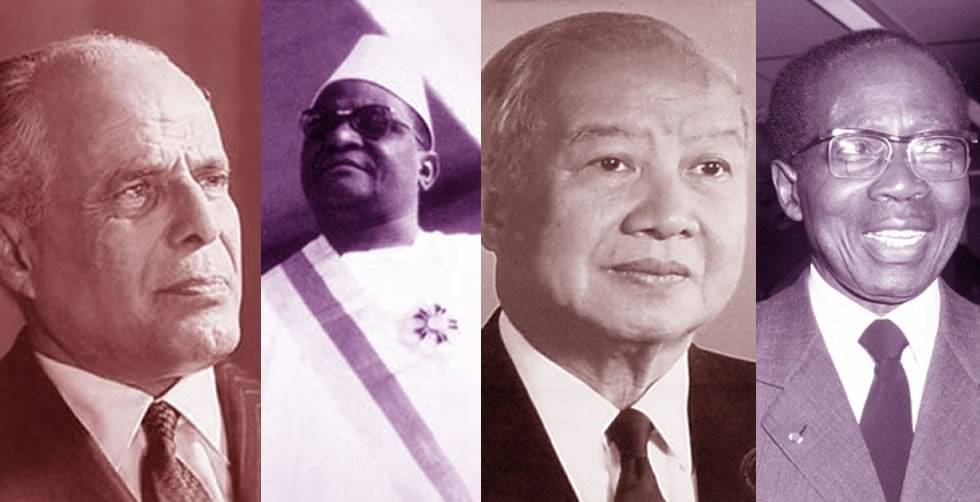
On February 17, 1969, at the invitation of Nigerien President Hamani Diori, with the support of Samdech Preah Norodom Sihanouk, Head of State of Cambodia, Léopold Sédar Senghor, President of Senegal, and Habib Bourguiba, President of Tunisia, a meeting of representatives from nearly 30 French-speaking countries was held for the first time in Niamey. Its objective was to give an institutional form to multilateral cooperation among countries using French, with a view to establishing cultural and technical unity among them. On February 20, participants adopted a resolution recommending the creation of a permanent structure, emphasising that multilateral cooperation must be conducted in strict respect for the sovereignty of states and the promotion of their respective national cultures.
As President Hamani Diori declared a year later, “The most authoritative voices expressed, with clarity and eloquence, the profound aspirations of nearly 200 million people who were conscious of belonging to the same community and determined to organise this community institutionally in order to affirm and develop—in fraternal equality—multilateral cooperation in education, culture, science and technology.”
The following year, on March 20, 1970, also in Niamey, representatives of 21 states sharing the use of French adopted the Convention establishing the Agency for Cultural and Technical Cooperation (Agence de Coopération culturelle et technique – ACCT). It was an intergovernmental organisation founded on the sharing of a common language, French, and tasked with promoting and disseminating the cultures of its members while strengthening cultural and technical cooperation among them.
Concrete Achievements of the ACCT
In 1978, the International Council of French-Language Radio and Television (Conseil international des radios-télévisions d’expression française – CIRTEF) was established. Today, it comprises 44 radio and television broadcasters that use French either entirely or partially. It promotes cooperation among them through programme exchanges, co-productions and professional training.
In 1979, at the initiative of Jacques Chirac, Mayor of Paris, mayors of capitals and major cities where French was spoken either entirely or partially established their own network: the International Association of Francophone Mayors (Association internationale des maires francophones – AIMF).
In 1984, the French-language television channel TV5 was launched through an alliance of five public television broadcasters: TF1, Antenne 2 and FR3 from France; RTBF from the French Community of Belgium; and TSR from Switzerland. They were joined in 1986 by the Quebec-Canada Public Television Consortium. TV5 Afrique and TV5 Amérique Latine were launched in 1992, followed by TV5 Asie in 1996, then TV5 États-Unis and TV5 Moyen-Orient in 1998. Renamed TV5MONDE in 2001, the network now comprises seven television channels, alongside TV5 Québec Canada. Available in more than 300 million households worldwide, it serves as the principal vehicle for promoting Francophonie in all its forms of expression and the diverse cultures it represents.
In 1986, the first Centre for Reading and Cultural Activities (Centre de lecture et d’animation culturelle) was inaugurated. These centres provide people in rural areas and disadvantaged neighbourhoods with access to books and culture. Today, more than 300 such centres operate across approximately 20 countries.
In 1988, the ACCT established an Image Fund, which has since supported the production of thousands of film and television works.
In 1993, the first African Performing Arts Market (Marché des arts du spectacle africain – MASA) was held in Abidjan, Côte d’Ivoire. At the same time, a programme was launched to support the circulation of artists and their works, focusing on performing and visual arts.
In 2001, the Agency established a new literary award, the Francophonie Five Continents Prize (Prix des cinq continents de la Francophonie), which recognises a French-language novel each year. Prominent figures in Francophone literature have supported the initiative, with Jean-Marie Gustave Le Clézio, René de Obaldia, Vénus Khoury-Ghata and Lionel Trouillot among the members of its jury.
A New Political Dimension
The Summit of Heads of State and Government of Countries Sharing the French Language, commonly known as the Francophonie Summit, was held for the first time in 1986 in Versailles, France, at the invitation of French President François Mitterrand. Forty-two states and governments participated and identified four key areas for multilateral cooperation: development; cultural and communication industries; language industries; and technological development combined with research and scientific information.
Since 1986, 19 Francophonie Summits have been held. Before the 20th Summit, which will take place in Phnom Penh, the three most recent summits were held in 2018 in Yerevan, Armenia; in 2022 in Djerba, Tunisia; and in 2024 in Villers-Cotterêts and Paris, France. These high-level political consultations have strengthened Francophonie’s position on the international stage while expanding its areas of action and improving its structures and operational methods.
Since 1995, the Francophonie has had the position of Secretary-General, with the first Secretary-General elected in 1997. The position went to Mr. Boutros Boutros-Ghali, former Secretary-General of the United Nations. At the Hanoi Summit that same year, the Francophonie Charter, the organisation’s principal reference document, was adopted.
In 2002, Mr. Abdou Diouf, former President of Senegal, became Secretary-General at the Beirut Summit. He gave fresh impetus to the political action of the International Organisation of La Francophonie (OIF) and its development cooperation efforts.
In 2014, at the Dakar Summit, Ms. Michaëlle Jean, former Governor General of Canada, became Secretary-General. In 2016, she secured the adoption of reforms in Antananarivo, Madagascar, aimed at streamlining Francophonie’s structures and operational methods. The name “International Organisation of La Francophonie” (OIF) was adopted.
In 2018, following the Yerevan Summit in Armenia, the current Secretary-General, Ms. Louise Mushikiwabo, former Minister of Foreign Affairs of Rwanda, took the helm of the OIF. She was reappointed in 2022 at the Djerba Summit.
Over the course of the summits, Francophone cooperation has expanded beyond its original areas of culture and education to include political issues such as peace, democracy and human rights, as well as sustainable development, the economy and digital technologies. The Francophonie Institute for Sustainable Development (Institut de la Francophonie pour le développement durable – IFDD) was established in Quebec in 1988, while the Francophonie Institute for Education and Training (Institut de la Francophonie pour l’éducation et la formation – IFEF) was established in Dakar in 2015.
Between 1970 and 2026, countries sharing the French language have developed into a structured and active community comprising 90 member states. Over 56 years, the dream of transforming a common language into an instrument of sharing, development and peace for 396 million people has become a reality recognised on the international stage.


By C. Nika
(Original version in French by Raoul M. Jennar)


