 KH
KH  FR
FR  AR
AR CN
CNFighting typhoons, heat and floods, Chinese farmers weather extremes to safeguard grain harvests
AKP Phnom Penh, 23 September, 2026 —
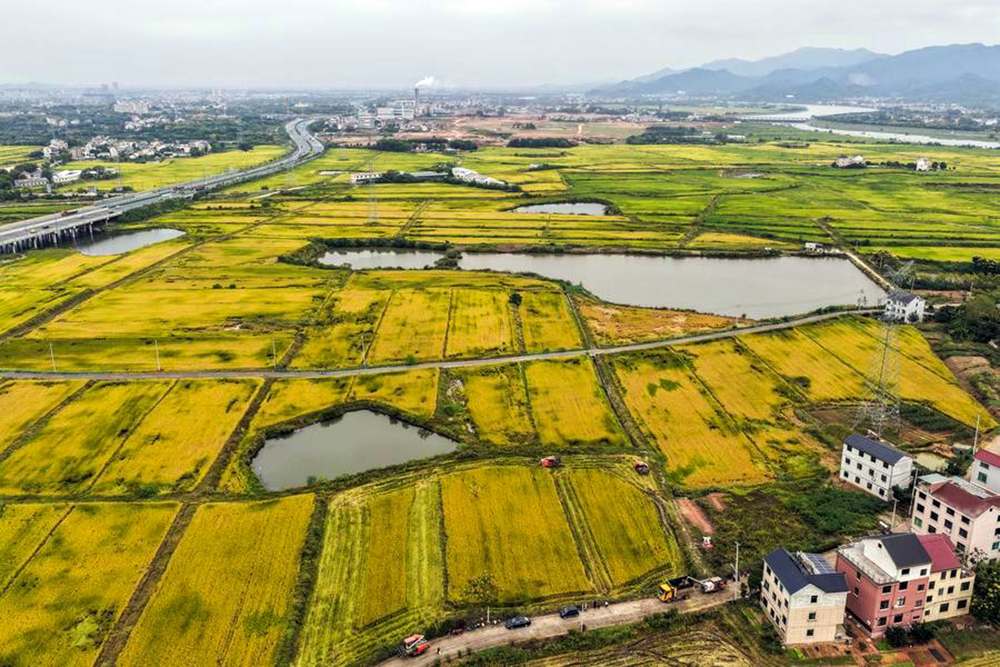
Rice grower Lu Weijun is preparing for harvest in about two weeks, as the crop enters the final stage of ripening, with stalks standing firm across fields in Quanjiao County, east China's Anhui Province.
A month earlier, however, the crop faced a test. "The weather forecast showed a typhoon was coming over the weekend, so we used 10 irrigation machines to pump water into the fields in advance," Lu recalled.
The measure worked. The added layer of water helped support the rice plants against strong winds, making them less likely to bend or topple. After the typhoon passed, Lu quickly drained the excess water to prevent waterlogging.
As China marks the Chinese farmers' harvest festival on Wednesday, autumn crops across the country have entered a critical stage of yield formation after weathering repeated bouts of extreme weather throughout the growing season.
Typhoons, torrential rain, heatwaves and droughts are increasingly challenging China's grain production. As one of the countries most severely affected by natural disasters, China is strengthening agricultural resilience through better infrastructure, new technologies and stronger disaster-response capacity, while shifting the focus from post-disaster relief toward prevention.
High-standard farmland serves as an important first line of defense against extreme weather, with improved irrigation and drainage systems helping crops withstand both drought and flooding.
For Chen Zhanchao in Changling County, northeast China's Jilin Province, that resilience is easy to see. The area was once known for suffering drought "nine years out of ten." In recent years, efforts to build high-standard farmland have accelerated in Chen's village, with drip irrigation systems installed to deliver water and fertilizer directly to crops.
"Once the valve is opened, water, sometimes mixed with fertilizer, flows through the drip lines directly into the fields," Chen said. "It saves water and fertilizer and is easy to use."
Across China, more than 1 billion mu (about 66.67 million hectares) of high-standard farmland has been built. This year, the Ministry of Agriculture and Rural Affairs has sent more than 20 work teams to major production areas to help farmers raise yields through appropriate dense planting and integrated water and fertilizer management techniques.
As China's agriculture becomes more digital, satellites, drones and smart machinery are giving farmers new ways to respond to extreme weather and limit crop losses.
For Cheng Long, who heads a grain and cotton cooperative in Huimin County, east China's Shandong Province, this autumn's challenge came after days of rain. Newly harvested corn had a moisture content of more than 30 percent, raising the risk of mold and sprouting within days.
Two large drying towers installed by the cooperative this year offered a solution. Cheng said the towers can bring moisture down to safe storage levels in less than half a day.
Technology is also speeding up damage assessment. Using radar satellites, drones and field monitoring stations, local authorities can quickly map different levels of corn lodging and complete a damage assessment across the township within 24 hours.
With that information, Cheng and other farmers can pinpoint damaged and waterlogged fields, drain excess water quickly and take targeted measures based on the severity of the damage.
Agricultural insurance has become a key policy tool for protecting farmers' enthusiasm for grain production, providing a safety net against disaster risks and helping stabilize expected returns from growing grain.
This year, the central government implemented 16 policy measures supporting agriculture, including subsidies for agricultural insurance premiums, with full-cost and planting income insurance for rice, wheat, corn and soybeans available nationwide.
For Ma Jianjun, a farmer in Wudi County, east China's Shandong Province, that protection proved crucial after low temperatures damaged his wheat in March. Ma had insured 906.1 mu of wheat for 2026.
After Ma filed a claim, the insurer used satellite imagery to gauge the extent of the damage before sending claims staff into the fields. Drones and measuring equipment then assessed the affected area and estimated losses.
In the end, 581.8 mu of Ma's wheat was found to have suffered varying degrees of yield loss, resulting in a payout of 203,600 yuan (30,400 U.S. dollars) that helped him resume production.
Despite serious weather-related damage in some parts of China this year, the Ministry of Agriculture and Rural Affairs' latest crop monitoring shows that autumn grain acreage has increased slightly and crops are growing well overall.
The challenge extends well beyond China. The World Meteorological Organization said earlier this month that El Niño is set to become very strong in the coming months, raising the risks of extreme weather into 2027.
Global food security is also under growing strain from geopolitical conflicts that have disrupted transport and raised fertilizer and production costs. A UN report released in July estimated that about 645 million people, or 7.8 percent of the global population, faced hunger in 2025.
Against this backdrop, China has continued to strengthen the foundations of its food security. Liu Huanxin, head of the National Food and Strategic Reserves Administration, said earlier this week that China's grain market has remained generally stable and the country's food security is well guaranteed.
China's annual grain output exceeded 700 million tonnes in both 2024 and 2025. A five-year agricultural and rural modernization plan targets comprehensive grain production capacity of around 725 million tonnes by 2030.
AKP-Xinhua